
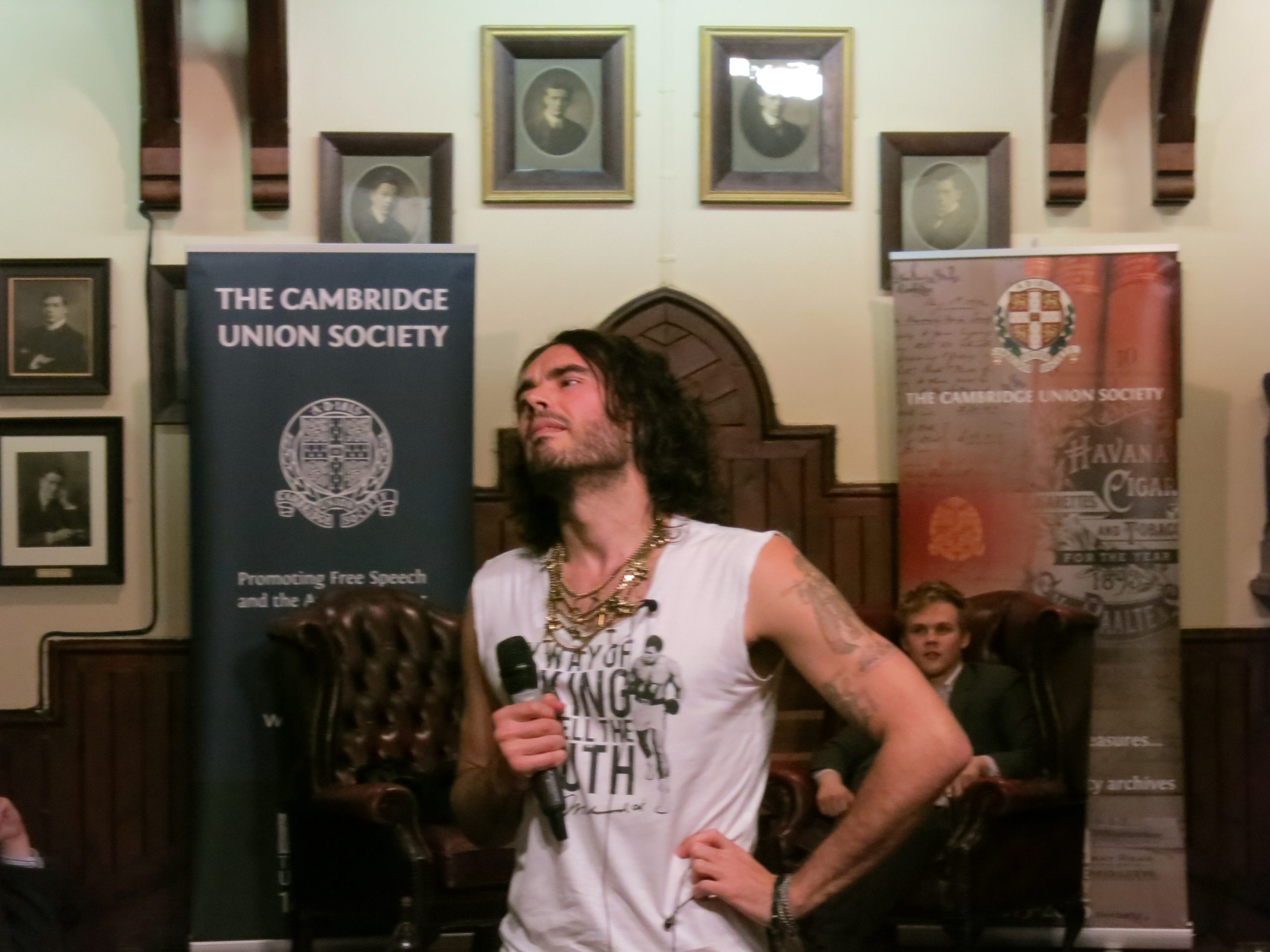
Russell Brand at the Cambridge Union Society (1-13-14 Wikimedia Commons User:Cantab12)
Trigger Warning: Proceed with Care
She said it was rape. He said it was consensual.
This all-too-common scenario not only frustrates our judicial system, but it also divides men and women around a topic on which they desperately need to find common ground.
What makes Russell Brand’s denials of rape stunning, is that several of his victims have the text messages to prove it. He apologizes in those messages.
And yet many people continue to defend Brand.
It can be difficult to accept that people we admire or find charming and funny might also have a dark side. But some of the arguments in favor of Brand are blatant victim blaming and pander to myths about rape. That suggests a disturbing dimension in our norms and assumptions around men, women, sex and consent.
What might this celebrity rape case help us understand about how we see rape, especially when it applies to our personal sex lives?
I’ve been raped three times as an adult woman.
And I have been asking myself lately, whether my rapists knew they raped me.
I’ll never know for sure, because I did not ask them then and I have no idea how to contact any of these men today. And even if I did confront them, they would almost certainly deny committing a crime.
Years ago, I did report two of the rapes.
But those rape reports went exactly nowhere because, at the time, law enforcement was still mired in victim blaming. One officer smirked at me as he disdainfully informed me that there was no way he was going to charge my coworker for raping me while I was unconscious. After all, I had been drinking so the rape was my fault.
The other rape was perpetrated by a violent serial rapist. But he “wisely” chose to prey upon sex workers, and the Oakland Police Department could have cared less.
Don’t prostitutes “deserve “to be raped?
Fortunately, California has since passed laws making it clear that sex workers deserve legal recourse for assault and rape. But that only happened because sex worker activists, including me, worked to bring pressure on politicians who feared being outed for refusing to prosecute rapists.
The first time I was raped, was probably a more typical rape scenario. We were both college sophomores living in a coed dorm. I had a crush on him even though we had never met. I was drawn to his over-the-top flirtatious, almost dangerous charm, not unlike that of Russell Brand. Tall, dark and sexy, his long hair pulled to the side to reveal a feather earring; his crazy eyes seemed to promise excitement and adventure. I told my girlfriend I was attracted to him, so she arranged for us to share a pizza in a group setting. After one slice of pizza, she and her boyfriend left me alone with him.
I welcomed his first kiss.
But then things quickly went sideways as he took control of my body with impunity. I froze, unable to move or speak, and he used my mouth like a human toilet. When he was finished, he dismissed me like I was trash. I felt humiliated but I didn’t yet understand what had happened. It felt like rape, but why didn’t I fight back or say no? It would be years before I learned about tonic immobility and how this freeze response effects a large majority of rape survivors.
Fortunately, long before that, my training as a volunteer for our local rape and domestic violence center helped me understand it didn’t just feel like rape. It was rape.
But did he know it was rape?
He certainly had a rehearsed way of subduing me. It felt like he had recited it many times in his young life.
“Don’t worry, I won’t put ‘it’ there,” he assured me. Had he “consoled” many other women with these words while assaulting them? Were we supposed to be impressed that he didn’t intend to penetrate us vaginally?
He obviously knew he was overstepping but did he think it was rape?
I think it more likely that as an entitled little shit who was used to taking what he wanted, he probably thought any girl who made the mistake of coming to his dorm room, was “fair game.”
Do They Think Some Women Deserve to be Raped?
The attitude that some women deserve to be raped shaped the Oakland PD’s callous attitude about the rape of prostitutes. Their posture was shared by a lot of people and still is in some circles. Women who have had a certain amount of sex and/or a certain kind of sex, are all too often seen as “legitimate” targets for sexual assault.
Researchers call this “rape supportive attitudes” which include these dangerous beliefs: women say “no” when they mean “yes”; women who dress provocatively, drink alcohol, or go someplace alone with a man are asking to be raped; women can resist a rape if they try; and a husband cannot rape his wife.
We saw evidence that more than a few men feel entitled to rape their girlfriends and wives when websites like MotherLess.com and the so-called “rape academy” entered the news cycle.
What sort of marriages and relationships did these men have with their wives and girlfriends when they weren’t drugging and raping them? Were they kind and caring? Did they go to church with their spouses before or after raping them?
Gisele Pelicot characterized her husband as kind, caring and attentive. But as we now know, for ten years he was also drugging her so he could film dozens of strangers raping her. How did he face her the next day when she was conscious? Ten years is a long time. Did Dominique Pelicot imagine that he was a “good husband?”
Do Rapists Think Rape is Romantic?
What would you think if I told you that every single one of my rapists, even the serial rapist, acted as if we were friends after they assaulted me?
The guy in college waved enthusiastically to me a few weeks later as he drove by in his little red sportscar. I was stunned. How could he think we were friends after what he did to me?
And the coworker who raped me for hours while I was unconscious and repeatedly mumbling the words “no?” (I only know I said “no” because he told me that I did once I regained consciousness.) He brought me a dozen roses and breakfast in bed. I think he honestly thought I was now his girlfriend.
Once the serial rapist allowed me to leave his apartment, his parting words were “I had a wonderful time and can’t wait to see you again!” He said the same words to a fellow sex worker after he raped her. Three weeks after he raped me, this man stabbed an eighteen-year-old sex worker in the face because she fought back. He was a violent, repeat sex offender but still nursed the fantasy that all the women he assaulted were his girlfriends. Well, perhaps all but the ones he stabbed.
The serial rapist had a lot of fantasies. He envisioned himself a heroic military veteran who sang in his church choir. And even though his apartment had bars on the windows and the door, even though anyone who entered was immediately trapped because the only way out was locked and he had the key, even though the payment he promised came in the form of phony check and even though he was willing to resort to violence with a deadly weapon; despite all that evidence to the contrary he was sure he enjoyed an amiable and mutually rewarding connection with about twenty victims a month (the bank verified he was bouncing that many checks of similar amounts).
What about the coworker who was certain he had laid claim to me by raping me and was now attempting to turn that rape into a romance?
He had spent a large portion of his life incarcerated. Was rape the only sexual connection he ever knew? He was our top technician – brilliant at what he did. But he also lacked social skills and frightened everyone at the office including the male supervisors. His routine intimidation and domination of others allowed him to do whatever he pleased – come in late, refuse to do certain jobs, talk back to his boss, etc. We put up with him because of his specialized skills as a telephone technician. And even after he raped me, I had to interact with him at work every day. It was frightening, demeaning and infuriating. And it was the 80’s. Rape was still prosecuted by interrogating the victim’s character and according to the legal system, my drinking meant I had none.
What about the college student? He came from a family that has established roots in our college community and our alma mater.
And since Google is so helpful in tracking people down, I just this minute found his Facebook page. He’s now a typically out of shape man in his 60’s with a son and apparently no current wife. His passion is photography and one of those photos features the church he “grew up in.”
So, he was a “good boy?”
I’m feeling a bit nauseous right now. The mundane reality of many men who rape is just so overwhelming.
Which is why I find myself interrogating this question: Do men know when they have committed acts of rape?
Sex Addiction? Denial? Gaslighting? Narcissism?
Even after being convicted and sentenced to over ten years in prison, Russell Brand continues to excuse and minimize his actions. He frames his past sexual behavior as “beyond reckless philandering” and misusing his fame to gain sexual access. He insists that all his sexual encounters were consensual and that for him, consent is “fundamental.”
The words he uses to minimize the rapes he committed must land as another form of abuse for his survivors. It would for me. Phrases like being “a bit greedy” and liking “flesh,” “carnality,” and “sex” paint him as a “naughty boy” whose worse offense might be sex addiction. But certainly not rape.
For me, as a rape survivor, it feels all too familiar. A sexually predatory man painting his perpetrations as “sexual adventures” to bolster his sagging sense of self.
Research also shows that men who perpetrate rape often have distorted beliefs such as “no” means “yes” and that their victims eventually “relaxed and enjoyed it.” How messed up is that? Since many women who are assaulted, freeze and submit to survive, some rapists use the presence of those survival mechanisms as “proof” that the sexual encounter was consensual.
Although these sorts of self-serving justifications may point to narcissism and other abusive personality traits in some men, the fact that non-consensual sexual behavior is widespread, suggests we shouldn’t dismiss all the men who perpetrate as simply defective or evil.
We need to go deeper and look at assumptions and stereotypes about sex and consent across all genders.
Rape Culture
What do we believe about courtship, dating, and seduction? And how and why do so many sexual encounters that begin consensual devolve into sexual assault?
A lot of what we learn about courtship, dating, seduction, sex, and relationships comes from music, movies and porn. Which is pretty depressing, because most of that entertainment is steeped in falsehoods. In fact, a lot of our entertainment glamorizes sexual encounters that are on the verge of assault.
The sexy guy who grabs the girl for a kiss after they have argued? The girl who plays hard to get while the guy relentlessly stalks her? Those themes are presented in Romcoms as the sexy highlight of the film.
And how about song lyrics that promote rape culture? A recent survey of top Billboard songs over the last ten years found that 70% contained rape myths such as blaming victims, framing victims as liars, assuming consent without communication and coercing partners into having sex.
Of course, most of us know that mainstream porn is lousy with nonconsensual and even brutally violent “sex” scenes. Sadly, porn is where many of today’s children first learn about sex. The average age of first exposure? Ten or eleven.
Before you assume I’m in favor of censorship, I’m not. I believe there is a better way for us to replace a culture that fosters and facilitates non-consensual sexual activity.
Rather than less information, I am always in favor of more. More education about mutual sexual pleasure and affirmative consent.
We also need more education about normal physiological functions like tonic immobility.
I’d like to see approaches to sex ed that highlight the sensual joys of honoring boundaries, communicating consent and engaging emotional intimacy during sex. We need role models of all genders who can show us how sexy consent is – even and especially when it includes consensually negotiated power play.
What would it be like if our porn, our music and our movies illustrated how hot consensual sex is?
Conquest Culture
Conquest culture, as it’s sometimes referred to, approaches sex like a competitive sport with winners and losers. Women are dehumanized, objectified and manipulated by a variety of tactics including gaslighting, undermining her sense of self, separating her from her friends and otherwise destabilizing her so that it’s easier to extract sex from her. The goal is conquest – not connection. And as such, it is inherently hostile and abusive even if hidden behind a veneer of charm and love bombing.
This “hyper-masculinity” is based upon double standards where a man “wins” when the woman “loses,” and what women most often lose in these dynamics is their right to say no.
Despite the rough exterior of a man like this, his behavior belies a great deal of fear.
Fear of being “less of a man.” Fear of not getting access to sex at all. Fear of intimacy. Fear of authentic emotional connection. Fear of rejection. Fear of being inadequate. Fear of losing power.
One need look no further than the false bravado of the Tate brothers to see what rape culture in the extreme looks like: Two little boys bragging and posturing nonstop because to be truly human for even one minute, risks revealing how vapid and empty, they actually are.
Kinky Culture
While many men who perpetrate are repulsive, let’s be clear that this is an us problem. We are all, regardless of gender, steeped in rape culture. We may not want to admit it, but most women (61%) have at least occasionally entertained rape fantasies.
I have.
And as a rape survivor, I can tell you there is ZERO similarity between being raped and fantasizing about a forced sex scenario. None. Rape is deeply damaging and traumatizing. Sexual fantasies are hot because they allow us complete control over edgy scenarios that would be utterly unwelcome in real life.
So, I’m absolutely NOT suggesting that women’s rape fantasies invite actual rape. But I am curious about the desire to be overwhelmed with a man’s sexual desire and how that might confuse some sexual interactions.
If I’m “playing hard to get” while hoping that my “faux boundaries” will be bypassed by his “uncontrollable desire for me,” does that contribute to the confusion of when consensual sex can become nonconsensual?
This is where I truly believe that kink awareness and the healthy negotiating skills that most kink communities teach around consent and power play, could really help all of us, regardless of our erotic preferences.
Many humans are wired to chase and subdue or resist and finally submit. It’s got a name: BDSM. What might it look like if everyone attended consent workshops like so many kinky people do? Maybe then, even vanilla couples could enjoy the thrill of power play while adhering to protocols that ensure ongoing consent.
Some Men are Raped Too
In this article, I’ve focused on men who rape women. The rapes I discussed were perpetrated by men and their victims were women. But men suffer rape too. And it’s not just men who rape men. Sometimes women rape men.
Almost no one believes that is possible. But it is. If you doubt that, you might not know that a penis can achieve an erection due to fear. Regardless of gender or sex, genitals can become aroused and even climax during a stressful or violent situation. Again, what a sad situation that so many of us don’t know how the human body works or what true consent looks like.
If you want to learn more about the ins and outs of consent, I recommend my colleague, Betty Martin’s Wheel of Consent. Her videos and trainings are for anyone of any gender identity, sexual orientation or erotic preference.
You can learn more about it here: https://www.wheelofconsent.org/
You might be wondering if I intend to contact the first man who raped me. Even though I discovered how I could do that while writing this article, I doubt it. For me, sharing what he did with you, has a lot more value than subjecting myself to what I assume would be a litany of excuses – or worse – complete amnesia about ever having known me.
“I never met that woman” echoes through the halls of the White House. I don’t need to hear the same from someone who brought darkness to my early years in college.
But I would like to hear from you. What resonated? What irritated? What was shocking and what was confusing? I’m always here for the conversations that take us closer to our healing and sexual sovereignty.